University of Wisconsin Logo
University of Wisconsin Mark

All In Wisconsin

  • Our Impact
  • About Us
  • Faculty & Staff
  • News
Search Icon
Universities of Wisconsin Constellation
Browse all sites
  1. Universities of Wisconsin
  2. All In Wisconsin
  3. Campus Stories
  4. Recycling lithium from old electric vehicle batteries could be done cheaply with new electrochemical process

Recycling lithium from old electric vehicle batteries could be done cheaply with new electrochemical process

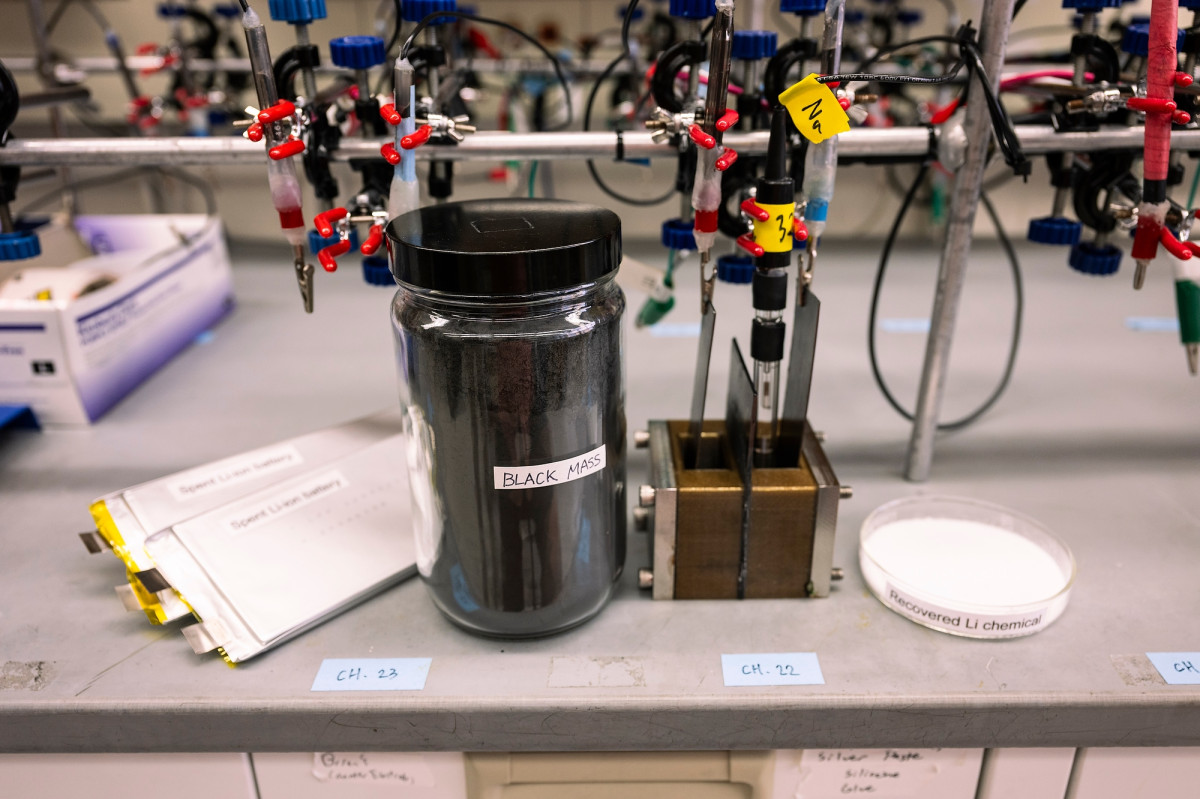
Photo: Chemistry Professor Kyoung-Shin Choi’s research lab has developed an electrochemical method to recycle lithium that’s catching the attention of electric vehicle makers. Photo: Jeff Miller / UW–Madison
Chemistry Professor Kyoung-Shin Choi’s research lab has developed an electrochemical method to recycle lithium that’s catching the attention of electric vehicle makers. Photo: Jeff Miller / UW–Madison

With ever more electric vehicles on the road, regulators and automakers are considering what can be done with the millions of batteries that power EVs after they’re spent. Even when their useful life is over, EV batteries contain valuable lithium that could theoretically be recycled and used in new batteries, but coming up with a cost-effective way to do so is critical.

Now, a group of University of Wisconsin–Madison chemists are hopeful they’ve found a solution, and they’re already filing patents and courting global carmakers.
Three people stand together for a portrait in a chemistry lab.
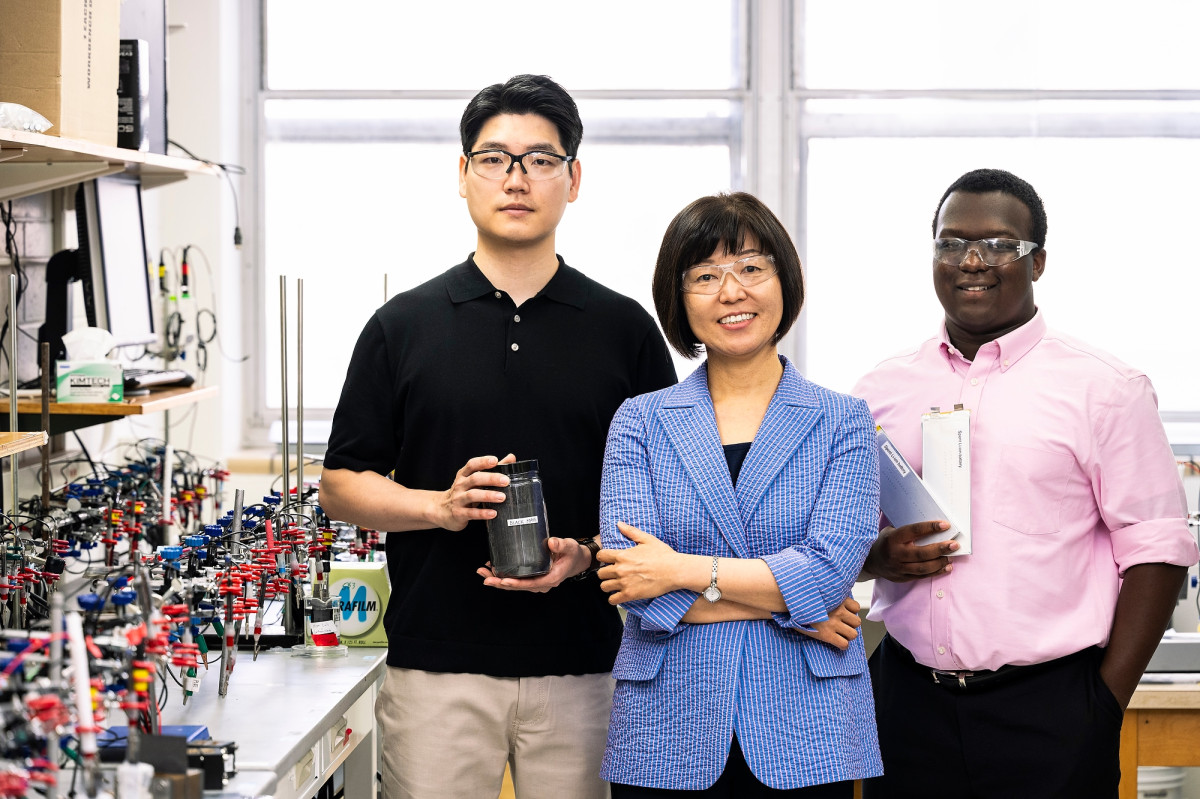
Pictured from left to right, staff scientist Dohwan Nam, chemistry professor Kyoung-Shin Choi and graduate student Brian Foster have developed an electrochemical method to recycle lithium in spent lithium iron phosphate batteries from electric vehicles and other applications as pure lithium chemicals to make new batteries. Photo: Jeff Miller / UW–Madison 

The work has been led by Kyoung-Shin Choi, a UW–Madison chemistry professor who specializes in developing electrochemical processes for various ends. In this case, Choi and her colleagues have come up with a proof of concept for using electrochemistry to extract lithium from spent lithium-iron-phosphate (LFP) batteries, which have been widely adopted by major EV manufacturers like Tesla and China’s BYD.

Lithium-based EV batteries come in a few flavors, and while LFP batteries have lower energy densities than batteries that are based on elements like nickel, manganese, and cobalt, they’re significantly cheaper to produce and safer to operate. On the flip side, iron and phosphate aren’t worth much compared to nickel or cobalt, making LFP batteries less attractive from a recycling perspective.

“At this point, there’s no economically compelling method to recover lithium from spent LFP batteries even though the market is shifting to them,” says Choi, who noted that obtaining lithium from mines and brine deposits has many negative environmental consequences, even if it may be cheaper than recycling.

“Access to these natural lithium resources is also limited,” Choi says. “We need an innovative method that makes lithium recovery from spent LFP batteries commercially viable to support a circular and competitive battery economy.”

The problem has become all the more pressing for global carmakers since the European Union has new regulations aimed at reducing the environmental impact of batteries. Beginning in 2031, batteries in new EVs sold within the EU will be required to incorporate a minimum percentage of recycled lithium.
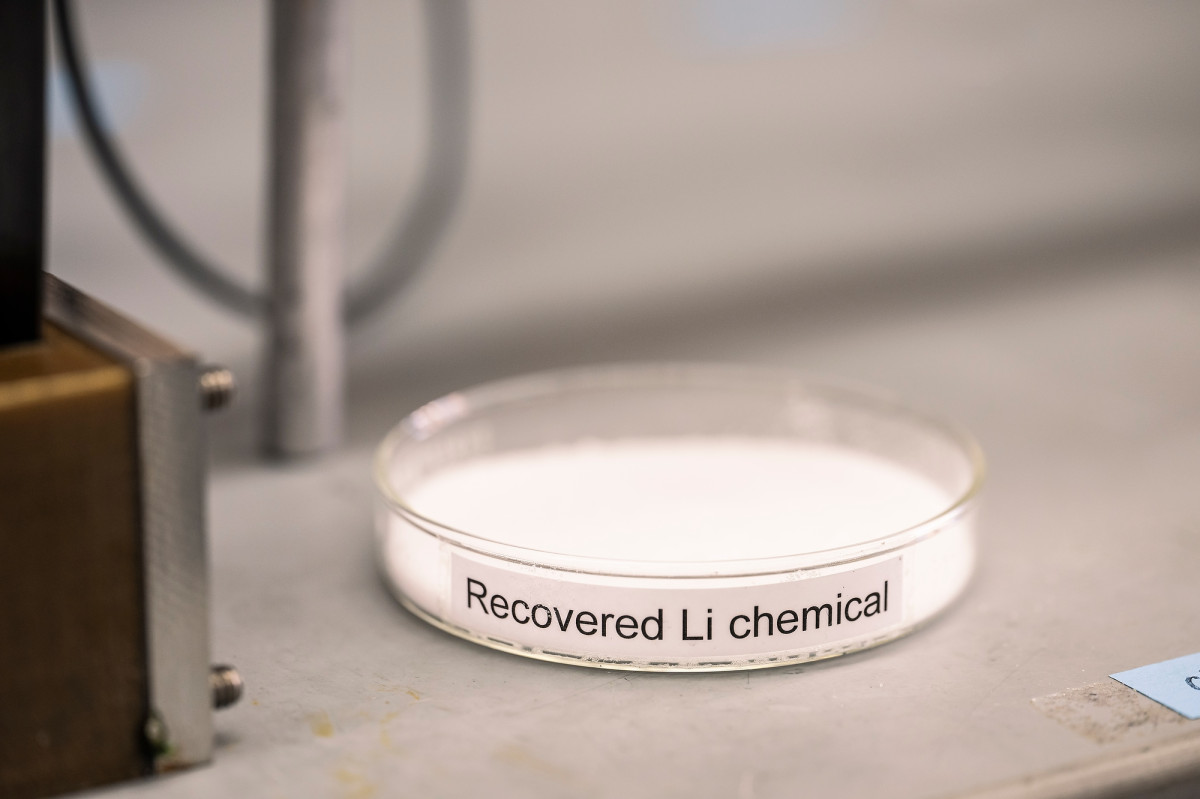
A petri dish with recovered white lithium powder
A dish of lithium phosphate recovered from an electrochemical experiment running in Choi’s research lab. Photo: Jeff Miller / UW–Madison 

Current methods for recovering lithium from spent batteries depend on energy-intensive heat or an extensive series of steps that consume a lot of chemicals and generate significant waste, Choi says.

“Both of them are economically unfeasible for recovering lithium from spent LFP batteries,” she says.

Instead, Choi developed a two-step electrochemical process that doesn’t require special conditions and minimizes chemical inputs and waste. The first step sees lithium ions leached out from spent LFP batteries and selectively extracted by a lithium-ion storage electrode. In the second step, the extracted lithium ions are released in a separate solution to recover them as high-purity lithium chemicals.

Choi and her colleagues have demonstrated the process’s viability using both a commercial LFP battery and black mass, which is an industrially mass-produced substance from spent LFP batteries. They recently detailed the process in the journal ACS Energy Letters and have filed a patent for it through the Wisconsin Alumni Research Foundation.

The work has begun to catch the attention of battery makers and automakers who are seeking new ways to bolster the resilience of the battery market and are interested in the commercial viability of the electrochemical process. Choi’s team is now developing a prototype of the technology to answer some outstanding questions about how to commercialize the process, and she’s forming a startup company in hopes of seeing it become successfully commercialized.

“The technology works, but it is important to scale it up in the most cost-effective manner,” Choi says, adding that it will be crucial for successful commercialization to streamline the technology with other steps in the overall recycling process such as the production and use of black mass.


This work was supported by Samsung E&A and the National Science Foundation Graduate Research Fellowship Program (2137424).


Written by Will Cushman
Link to original story: https://news.wisc.edu/recycling-lithium-from-old-electric-vehicle-batteries-could-be-done-cheaply-with-new-electrochemical-process/

Recents
  • UW-Milwaukee professor uses sport psychology research to solve real-world problems

    Tuesday, January 27, 2026

  • Community Capital: How Credit Unions and Universities Partner to Strengthen Wisconsin

    Monday, January 26, 2026

  • UW-Whitewater honored nationally for deep-rooted community impact

    Friday, January 23, 2026

Recents
Yearly
  • 2026
  • 2025
  • 2024
  • 2023
  • 2022
  • 2021
  • 2020
  • 2019
  • 2018
  • 2017
  • 2016
  • 2015
  • 2014
  • 2013
  • 2012
Monthly
  • January 2026
  • December 2025
  • November 2025
  • October 2025
  • September 2025
  • August 2025
  • July 2025
  • June 2025
  • May 2025
  • April 2025
  • March 2025
  • February 2025
  • January 2025
  • December 2024
  • November 2024
  • October 2024
  • September 2024
  • August 2024
  • July 2024
  • June 2024
  • May 2024
  • April 2024
  • March 2024
  • February 2024
  • January 2024
  • December 2023
  • November 2023
  • October 2023
  • September 2023
  • August 2023
  • July 2023
  • June 2023
  • May 2023
  • April 2023
  • March 2023
  • February 2023
  • January 2023
  • December 2022
  • November 2022
  • October 2022
  • September 2022
  • August 2022
  • July 2022
  • June 2022
  • May 2022
  • April 2022
  • March 2022
  • February 2022
  • January 2022
  • December 2021
  • November 2021
  • October 2021
  • September 2021
  • August 2021
  • July 2021
  • June 2021
  • May 2021
  • April 2021
  • March 2021
  • February 2021
  • January 2021
  • December 2020
  • November 2020
  • October 2020
  • September 2020
  • August 2020
  • July 2020
  • June 2020
  • May 2020
  • April 2020
  • March 2020
  • February 2020
  • January 2020
  • December 2019
  • November 2019
  • October 2019
  • September 2019
  • August 2019
  • July 2019
  • June 2019
  • May 2019
  • April 2019
  • March 2019
  • February 2019
  • January 2019
  • December 2018
  • November 2018
  • October 2018
  • September 2018
  • August 2018
  • July 2018
  • June 2018
  • May 2018
  • April 2018
  • March 2018
  • February 2018
  • January 2018
  • December 2017
  • November 2017
  • October 2017
  • September 2017
  • August 2017
  • July 2017
  • June 2017
  • May 2017
  • April 2017
  • March 2017
  • February 2017
  • January 2017
  • December 2016
  • November 2016
  • October 2016
  • September 2016
  • August 2016
  • July 2016
  • June 2016
  • May 2016
  • April 2016
  • March 2016
  • February 2016
  • January 2016
  • December 2015
  • November 2015
  • October 2015
  • September 2015
  • August 2015
  • July 2015
  • June 2015
  • May 2015
  • April 2015
  • March 2015
  • February 2015
  • January 2015
  • December 2014
  • November 2014
  • October 2014
  • September 2014
  • July 2014
  • June 2014
  • May 2014
  • April 2014
  • March 2014
  • January 2014
  • December 2013
  • November 2013
  • October 2013
  • September 2013
  • August 2013
  • July 2013
  • June 2013
  • May 2013
  • April 2013
  • March 2013
  • February 2013
  • January 2013
  • December 2012
  • November 2012
  • October 2012
Universities
  • Freshwater Collaborative of Wisconsin
  • Universities of Wisconsin
  • UW Colleges
  • UW Extended Campus
  • UW-Eau Claire
  • UW-Extension
  • UW-Green Bay
  • UW-La Crosse
  • UW-Madison
  • UW-Milwaukee
  • UW-Oshkosh
  • UW-Parkside
  • UW-Platteville
  • UW-Platteville; UW-La Crosse
  • UW-River Falls
  • UW-Stevens Point
  • UW-Stout
  • UW-Superior
  • UW-Whitewater
Categories
  • Community
  • Economic Development
  • Research & Innovation
Universities of Wisconsin
Facebook Icon X Icon LinkedIn Icon Instagram Icon YouTube Icon
Office of Public Affairs, Communications, and Branding
Madison, WI 53706

universityrelations@wisconsin.edu

Employee Intranet

© 2026 Board of Regents - University of Wisconsin System. All Rights Reserved

All Sites | Accessibility | Privacy | Contact Webmaster